
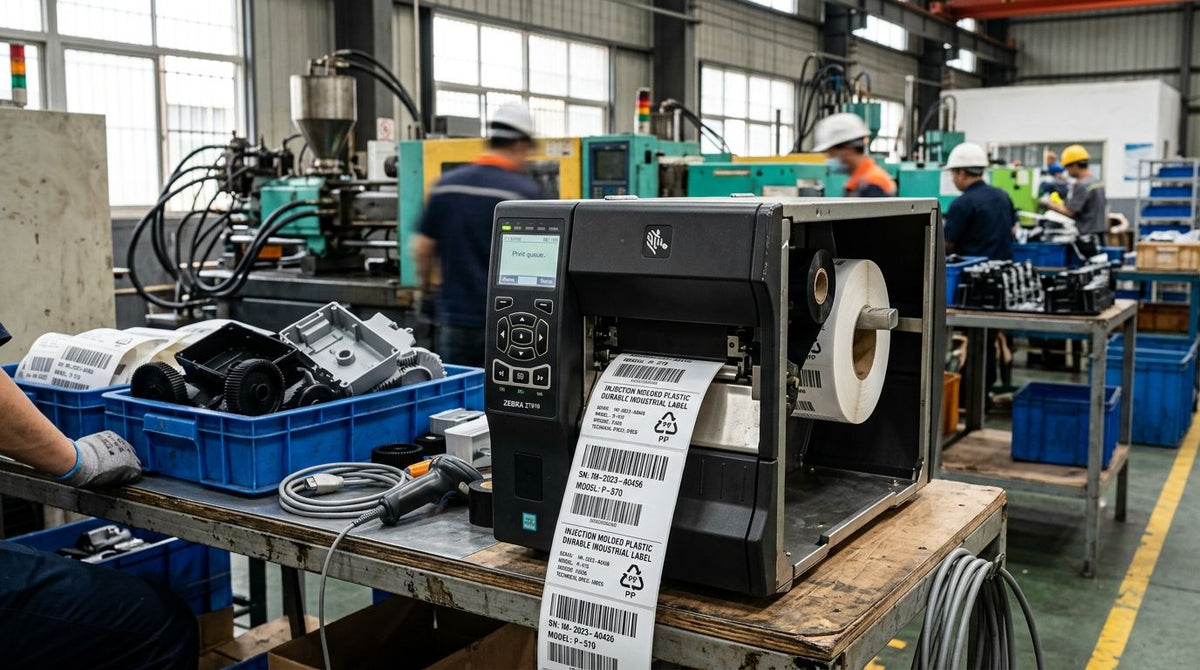
Industrial label printer for plastics and injection molding operations means thermal transfer printing systems paired with heat- and chemical-rated label stock built to survive mold release agents, hot resin dust, and cutting oil on the shop floor. Standard office label printers and paper labels fail within days near molding machines because direct thermal print fades under heat and adhesive lifts off oily surfaces. This guide covers what holds up on a molding floor in 2026 and what to buy first.
- GoDEX ZX430i+ at 300 DPI is the pick for small mold ID tags and dense barcodes on injection molding lines.
- Thermal transfer with resin ribbon beats direct thermal near presses because heat fades direct thermal prints fast.
- 3M Heavy-Duty Silver asset tags outlast metalized silver on molds and dies exposed to release agents.
- 203 DPI covers most part and carton labels; 300 DPI matters for small QR codes on mold plates.
- Test one roll against your actual mold release agent before ordering in bulk.
Why labeling matters for plastics and injection molding
A molding floor runs hotter and dirtier than almost any other environment McAuley Labels supplies. Injection presses radiate heat all shift, and labels sitting a few feet away absorb it continuously. Add hydraulic oil mist, mold release spray, and solvent wipe-downs, and a label rated for a warehouse shelf is the wrong tool.
The industrial label printer for manufacturing floors guide covers general shop-floor labeling. Injection molding adds a narrower problem: parts, molds, and resin bins all need barcodes that survive direct contact with release agents and repeated handling. In 2026, traceability audits are routine — a lot label that peels off in week one turns a batch question into a paperwork problem.
Update your label stock for heat and chemical exposure
Most plastics facilities default to whatever stock came pre-loaded on a desktop printer. Fix that first.
- Move to polyester label stock instead of paper for anything within a few feet of a press
- Match adhesive to the surface — release-agent residue needs a solvent-resistant adhesive, not a standard permanent one
- Confirm the label's rated temperature range covers your mold surface temp, not just ambient shop temp
- Test one small batch against your actual release agent brand before a full run
- Review how to choose label stock for high-heat environments before locking in a spec
Pick a printer resolution that matches your barcode density
Resolution decides whether a barcode scans reliably at small sizes on a mold plate.
- 203 DPI covers standard carton, bin, and part labels
- 300 DPI is the floor for small QR codes and dense data matrix codes on mold ID tags
- 600 DPI matters for regulated micro-text labeling, not typical molding parts
- Check your scanner's minimum module width before choosing — mismatches show up on the floor, not in testing
The GoDEX ZX430i+ at 300 DPI is the practical default for injection molding because it handles standard part labels and smaller mold ID codes on one machine. Verdict: Buy for facilities running mixed label sizes.
Standardize asset tags for molds, dies, and presses
Molds move between presses constantly, and a missing tag means a technician guesses at cycle history.
- Use 3M heavy-duty tags on molds and dies that see repeated cleaning cycles
- Use metalized silver tags for lighter equipment where exposure is lower
- Number tags sequentially and tie them to a maintenance log, not a loose description
- Place tags away from the parting line so cleaning doesn't scrape them off
- Pull formats from the heavy-duty silver barcode asset tags line rather than printing generic inventory stickers
Build a ribbon strategy before you scale up
Thermal transfer needs the right ribbon-to-label pairing, and this is where facilities waste the most money guessing.
- Wax ribbon works for basic paper labels on cartons and totes
- Wax/resin blends hold up on polyester labels facing moderate chemical exposure
- Full resin ribbon is the option for labels that see direct solvent contact
- Buy ribbon and label stock from the same supplier so the chemistry is matched
- A 2.25 in x 243 ft roll is a common size for compact desktop-format printers running mixed jobs
Print bin, rack, and lot labels for resin and finished parts
Molding facilities move high volumes of resin lots and finished parts through the same floor space every shift.
- Color-code labels by resin type to cut mis-picks at the hopper
- Print lot and batch codes at the press station, not later at a shipping desk
- Use barcode symbologies your ERP or MES already reads — don't introduce a new one mid-year
- Keep a spare label roll and ribbon at each press so a stockout never stops a changeover
Test durability before a facility-wide rollout
Skipping this step is the most common reason a 2026 labeling project gets redone six months later.
- Run one printed batch through your real cleaning and handling cycle for at least two weeks
- Check adhesion after exposure to your specific mold release agent, not a generic solvent
- Confirm barcode scan rates after handling, not straight off the printer
- Request volume pricing through the custom quote page once the test batch passes
Comparison: options for plastics and injection molding
| Option | Best for | Key limitation |
|---|---|---|
| Direct thermal labels | Low-heat bin and pick labels away from presses | Print fades under heat and light |
| Thermal transfer, wax ribbon | General carton and inventory labels | Limited chemical resistance |
| Thermal transfer, resin ribbon | Mold tags and parts near release agents | Higher cost per roll than wax |
| 3M Heavy-Duty asset tags | Molds, dies, presses in daily cleaning cycles | Higher unit cost than standard tags |
| Metalized silver asset tags | General equipment tracking, lower exposure zones | Less chemical resistance than 3M heavy-duty |
| GoDEX GX4200i, 203 DPI | Standard part and carton labels at speed | Not enough resolution for dense small codes |
| GoDEX ZX430i+, 300 DPI | Mixed part labels plus small mold ID codes | More resolution than simple 1D barcodes need |


Common mistakes plastics and molding facilities make
- Running direct thermal labels near presses. Radiant heat degrades the print long before the label itself fails.
- Skipping the chemical compatibility test. Release agent formulas differ by brand, so a label that survives one plant can fail at another.
- Undersizing barcode resolution. A 203 DPI printer struggles with a small QR code on a 1-inch mold tag; 300 DPI solves it without a system overhaul.
- Leaving molds untagged. Plants tag parts and bins carefully, then skip the molds — exactly where changeover and maintenance history gets lost.
- Mixing wax ribbon with resin-rated labels. Pair them correctly or both print durability and adhesion suffer.
“If the label survives the printer but not the cleaning cycle, you bought the wrong adhesive, not the wrong printer.”
FAQ
What is the best industrial label printer for plastics and injection molding?
The GoDEX ZX430i+ at 300 DPI is the strongest all-around pick because it prints standard part labels and small, dense mold ID codes on one machine. Plants running only large carton labels can use a 203 DPI model like the GoDEX GX4200i instead.
Is thermal transfer better than direct thermal for injection molding?
Yes. Thermal transfer with resin or wax/resin ribbon is the standard for molding floors because direct thermal print fades under heat. Direct thermal only makes sense for labels kept well away from press heat and chemical exposure.
How much heat can a printed label withstand near molding machines?
It depends on the label stock and adhesive rating, which vary by supplier, so check the rated temperature range before ordering. Polyester stock generally handles more heat than paper, but the adhesive is usually the weaker link.
What DPI do I need for small mold ID tags?
300 DPI is the practical floor for small mold ID tags and dense QR or data matrix codes. 203 DPI is fine for larger part and carton labels but struggles with fine barcode modules at small sizes.
Can asset tags survive mold release agents and cutting oils?
3M Heavy-Duty asset tags are built for repeated chemical and cleaning exposure and hold up better than standard metalized silver tags. Test a small batch against your specific release agent first, since chemistry varies by brand.
Do I need a ribbon to label plastic parts?
You need thermal transfer ribbon whenever the label faces heat, chemicals, or abrasion, which covers most injection molding environments. Direct thermal labels skip the ribbon but suit only low-exposure bin and pick labels.
How should I tag molds and dies for tracking?
Use a heavy-duty asset tag placed away from the parting line, numbered sequentially, and linked to a maintenance log. That keeps cycle history attached to the physical mold rather than a spreadsheet row.
What is the difference between metalized silver and 3M heavy-duty asset tags?
Metalized silver tags cost less and work for general equipment tracking in lower-exposure areas. 3M Heavy-Duty tags hold up through repeated cleaning cycles and chemical contact, which is what a molding floor delivers daily.
One last thing
The failure that triggers the most reprint requests in 2026 is not heat — it is adhesive breakdown from solvent cleaning wipes, which lifts the label before the print itself ever fades. Test adhesion after a real cleaning cycle, not straight off the printer, before you standardize a label across the plant.