
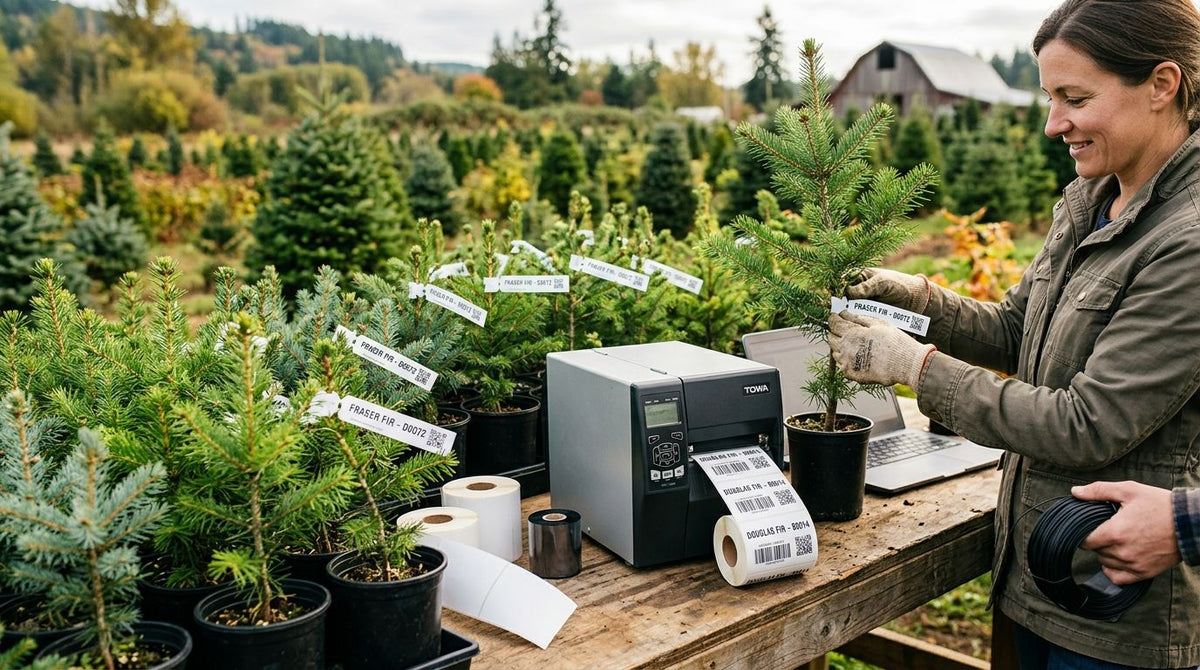
Tree farms and Christmas tree growers need a plant label printer that survives years of sun, frost, and rough handling in the field — not a printer built for a one-season nursery pot. A plant label printer for tree farms and Christmas tree growers is a thermal printing setup — printer, label stock, and ribbon working together — that produces species, lot, and block tags durable enough to stay attached to a tree from planting through a 6-to-10-year growth cycle. Nursery pot tags sit under shade cloth for a few months; tree farm tags ride through multiple winters wired to a trunk or staked in open ground, so material choice and print resolution carry more weight here than in almost any other plant-tagging segment.
- A plant label printer for tree farms and Christmas tree growers needs polyester stock and resin ribbon, not paper and wax.
- GoDEX ZX430i+ at 300 DPI prints small QR codes and dense variety text sharp enough to scan years after planting.
- A 203 DPI plant label printer handles basic species and lot text at lower cost when tags don't need dense codes.
- Batch tags by planting block before printing so lot numbers don't mix across acres of stock.
- Direct thermal and wax ribbon labels fade under UV within a single growing season on open-field tags.
Why plant label printers matter for tree farms and Christmas tree growers
A tree farm tags thousands of seedlings across multiple blocks in a single planting season, then doesn't touch most of those tags again until harvest, sometimes years later. Any label that fades, cracks, or falls off in that gap costs a grower the ability to match a tree to its planting record. Christmas trees typically take 6 to 10 years to reach harvest height, meaning a tag printed in year one has to survive winters, mowing equipment, and irrigation before anyone reads it again — the reason waterproof plant labels for outdoor stakes need different stock than shade-house pot tags.
Inventory tracking across dozens of acres also depends on the tag surviving intact. A grower running block-by-block counts for a 2026 harvest needs every tag from the 2020 or 2021 planting to still carry a readable barcode or lot number — not a guess based on row position.
Choose label stock rated for multi-season outdoor exposure
The cheapest way to tag a row is a paper nursery tag and a permanent marker. That works for a display bed. It does not work for four winters of freeze-thaw and irrigation.
- Polyester tags for UV and moisture resistance across multiple growing seasons
- Vinyl tags where flexibility matters in freezing temperatures
- Wire-on tags for trunks and branches versus adhesive-back tags for stakes
- Paper or direct thermal stock only for one-season nursery pots, never open-field tree rows
- Tear-resistant stock for tags handled repeatedly during shearing and pruning
Match printer resolution to species codes and lot numbers
Most tree farm tags only need clear text: species, planting year, block number. A 203 DPI plant label printer handles that at lower cost per tag, and the plant label printer 203 DPI compact precision model is built for exactly that kind of straightforward field text.
Growers running QR codes tied to a full planting record, or printing small variety names on narrow tags, need more resolution. 300 DPI holds small text and dense QR codes sharp enough to scan after years of sun exposure, which is where a printer like the GoDEX ZX430i+ thermal printer earns its keep over a basic 203 DPI unit.
- 203 DPI: species name, planting year, block number, basic barcodes
- 300 DPI: dense QR codes, small variety names, compliance codes on narrow tags
- Match resolution to the smallest text on the tag, not the average text
- Test a sample tag at arm's length before committing to a full print run
Set up thermal transfer instead of direct thermal for field durability
Direct thermal printing burns an image directly into heat-sensitive paper — no ribbon needed, but the image fades under UV within a single season outdoors. Thermal transfer runs a ribbon between the printhead and the label, and a resin ribbon on polyester stock holds ink through repeated freeze-thaw cycles far better than wax or wax/resin blends.
- Skip direct thermal for anything staying outdoors past one season
- Use resin ribbon on polyester for multi-year field tags
- Wax ribbon is fine for short-term paper tags moved indoors between uses
- Check ribbon width matches your label width to avoid waste
Print barcodes or QR codes for block and row tracking
The manual way: order pre-numbered tags from a print shop once a year and hand-write additions in the field. It works for a small operation but breaks down once a farm runs multiple blocks and species.
A faster path prints barcodes or QR codes in-house, tied to a spreadsheet or inventory system, so a handheld scanner pulls up planting date and lot history at harvest instead of a grower cross-referencing a paper map.
- Code 128 barcodes for simple lot and block tracking
- QR codes for linking a tag to a fuller planting record
- Sequential numbering within a block to catch missing or duplicate tags
- Batch codes tied to planting year, not just species
Batch print by planting block to avoid mixing tags
Running one huge print job for the whole farm invites mix-ups. Batching by block keeps lot numbers, species, and planting dates from bleeding into each other.
- Print one block's tags in a single run before moving to the next
- Label the ribbon or stock roll with the block name during the run
- Date each batch at the time of printing, not after
- Keep a paper log of which batch went to which field row
Calibrate and test tags before a full field run
A tag that scans fine on a desk can still fail outdoors. Test before committing thousands of tags to a season.
- Run one roll outdoors for a week and check for fading or curling
- Test wire or adhesive attachment in wind before mass application
- Scan a sample batch with the same handheld scanner used at harvest
- Confirm barcode contrast holds after a rain event, not just after printing


Comparing tagging options for tree farms
| Option | Best for | Key limitation |
|---|---|---|
| Paper tags + permanent marker | One-season flats, not field trees | Dissolves in rain, illegible within months |
| Direct thermal labels | Short-term indoor inventory counts | Fades under UV within a single outdoor season |
| Wax ribbon thermal transfer | Budget lot codes on paper or vinyl | Scuffs and fades faster than resin in direct sun |
| Resin ribbon thermal transfer on polyester | Multi-year field tags through harvest | Higher per-tag material cost than wax or direct thermal |
| Outsourced pre-printed wire tags | Growers who don't want an in-house printer | No control over changes once a batch is ordered |
Verdict: a plant label printer running resin-ribbon thermal transfer on polyester stock is the only option built for a Christmas tree's full 6-to-10-year field life — everything else is a stopgap for a single season.
Common mistakes tree farms and Christmas tree growers make
- Using leftover nursery paper tags outdoors, then finding half the block unreadable by the next spring
- Choosing 203 DPI when the tag design includes a small QR code, resulting in scan failures at harvest
- Running wax ribbon on tags meant to sit in direct sun for more than one season
- Printing an entire farm's tags in one batch instead of by block, then losing track of which lot came from where
- Skipping a field test and discovering adhesive failure only after tags start falling off in wind
FAQ
What's the best plant label printer for tree farms and Christmas tree growers in 2026?
A thermal transfer printer running resin ribbon on polyester stock is the best setup for tree farms in 2026 because it holds up through multiple winters outdoors. A 300 DPI model like the GoDEX ZX430i+ handles dense QR codes; a 203 DPI model covers basic species and lot text at lower cost.
Is direct thermal or thermal transfer better for Christmas tree tags?
Thermal transfer is better for Christmas tree tags because direct thermal printing fades under UV within a single outdoor season. Thermal transfer with resin ribbon on polyester stock survives years of field exposure.
Do I need 300 DPI or 203 DPI for tree farm tags?
Use 300 DPI if the tag includes a small QR code or dense variety text; 203 DPI is enough for basic species, planting year, and block number. Match resolution to the smallest text on the tag, not the average.
How long do plant tags need to last on a Christmas tree farm?
Christmas trees typically take 6 to 10 years to reach harvest height, so a tag printed at planting needs to survive that full window through freeze-thaw cycles, irrigation, and repeated pruning.
Can I use the same printer for tree tags and asset tags?
Yes, a thermal transfer printer that handles polyester plant tags can also print equipment or asset labels since both rely on the same ribbon-and-stock combination for outdoor durability.
What material holds up best for outdoor plant tags?
Polyester stock paired with resin ribbon holds up best for outdoor plant tags exposed to sun, rain, and freezing temperatures across multiple seasons. Paper and direct thermal stock are only suited to short-term, indoor use.
Should I print barcodes or QR codes on tree farm tags?
QR codes work better when a tag needs to link to a fuller planting record; simple barcodes are sufficient for basic block and lot tracking. The choice affects the print resolution you need, not just the printer itself.
One last thing
Growers who switch from wax ribbon to resin ribbon on the same polyester stock almost always report the change after a tag failure, not before one — testing a resin-ribbon batch on a handful of trees before a full planting season catches the difference for a fraction of the cost of a farm-wide reprint in year three.