
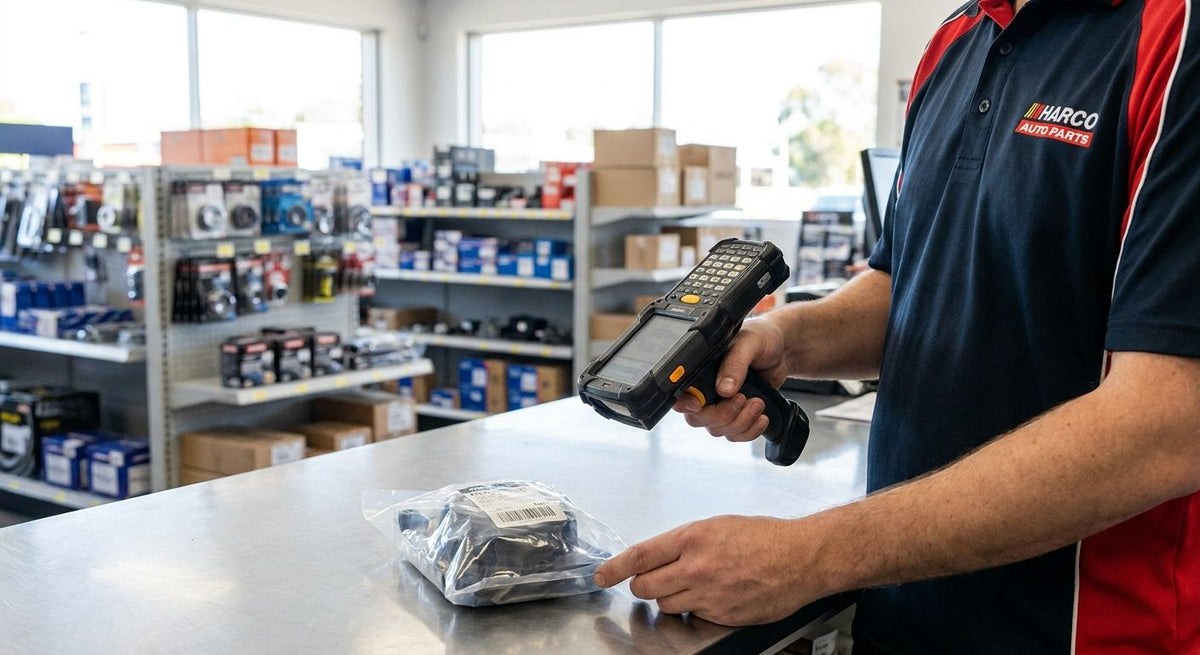
An auto parts counter doesn't need the barcode scanner with the most features — it needs the one that matches how parts actually get scanned: one register, greasy or scuffed labels, and the occasional VIN plate that laughs at a cheap laser scanner. This guide ranks four scanner types by the job each one does at a parts counter in 2026, not by spec sheet length.
- GoDEX GS220 USB scanner wins for single-register auto parts counters — plug-and-play, no drivers, 3-year warranty.
- A wireless 2D imager beats a 1D scanner once you're reading VIN plates or QR codes on OEM boxes.
- Bluetooth ring scanners only pay off once staff pull more than 50 line items a shift.
- Rugged industrial scanners earn their keep at a receiving dock, not at the front counter.
Why this matters
Auto parts stores run barcode volume most retail categories never see: SKU lookups on aftermarket parts all day, OEM boxes stamped with 2D data matrix codes, and VIN plates that get scanned repeatedly during a service rush. A scanner picked off a generic "best barcode scanner" list built for grocery checkout chokes on a scuffed metal VIN tag or a glare-heavy plastic parts bag.
The distinction that actually matters in 2026 isn't brand — it's whether the counter needs a fixed wired unit, a wireless imager for VIN and QR codes, or something rugged enough for a loading dock. Get the connection type wrong and staff end up re-keying line items by hand while inventory counts drift. A proper barcode label printer for automotive parts inventory setup solves the printing side of that problem; the scanner is the other half.
Most single-location parts stores overbuy here — they grab a wireless 2D imager built for a warehouse when a $70-class wired 1D scanner would cover 100% of what's on the shelf. The reverse mistake happens too: a store that scans VIN plates daily tries to make a basic 1D scanner work and ends up manually typing half its codes.
What makes the best barcode scanner for an auto parts store
- Symbology support — 1D (UPC, Code 128) covers standard aftermarket SKUs; 2D (QR, Data Matrix) is required for OEM boxes and most VIN plates.
- Connection type — USB wired suits one fixed counter; Bluetooth or 2.4GHz wireless suits staff moving through aisles or a backroom.
- Scan reliability on damaged labels — auto parts labels get greasy, scuffed, and shrink-wrapped; the scanner needs to read through that on the first pass.
- POS or inventory integration — keyboard-wedge (HID) output means the scanner works with existing register software with zero configuration.
- Physical durability — a busy counter means drops onto concrete; a scanner rated for repeated falls lasts years longer than one that isn't.
- Warranty length — a 3-year warranty signals the manufacturer built the unit for daily commercial use, not occasional home scanning.
Auto parts store barcode scanners at a glance
| Scanner type | Best for | Standout feature | Key limitation |
|---|---|---|---|
| GoDEX GS220 USB Barcode Scanner | Single-register parts counters | Plug-and-play USB, no drivers, 3-year warranty | Wired only, 1D symbologies |
| Wireless 2D handheld imager | VIN plates and OEM QR/Data Matrix codes | Decodes damaged, curved, and 2D labels | Base station adds setup and cost |
| Bluetooth ring scanner | Backroom pull lists and stock runners | Hands-free scanning while carrying parts | Shorter battery life, more moving parts |
| Rugged industrial 2D scanner | Receiving docks and outdoor or dusty bays | Sealed housing rated for drops and dust | Bulky and priced above counter needs |
1. GoDEX GS220 USB Barcode Scanner: best barcode scanner for single-register auto parts counters
The GoDEX GS220 is a wired USB 1D scanner built for exactly this counter setup — one register, one operator, constant SKU lookups on aftermarket parts. It runs as a keyboard-wedge device, so scanned barcodes type straight into whatever POS or inventory software the store already uses. No driver install, no configuration screen, no IT call. McAuley Labels backs it with a 3-year warranty, which matters for a device that gets picked up and set down hundreds of times a shift.
GoDEX GS220 pros:
- Plug-and-play — scanning starts the moment it's connected
- Works with any software that accepts keyboard input, no integration work required
- 3-year warranty covers daily counter wear
- Sized and priced for a single-terminal parts counter, not a warehouse budget
GoDEX GS220 cons:
- Wired tether keeps it fixed to one counter — no walking the aisles with it
- 1D only, so QR codes on OEM boxes and 2D VIN barcodes need a second device
- No battery, so it's not an option for backroom picking
Best for: a single-register auto parts store that scans standard aftermarket SKUs at checkout and doesn't need to read 2D codes.
Verdict: Buy if the counter is fixed and the shelf runs standard UPC or Code 128 labels — the 1D barcode scanner buying guide covers the same connection-type tradeoffs in more depth.
2. Wireless 2D handheld imager: best barcode scanner for VIN plates and OEM 2D codes
A 2D wireless imager reads both 1D and 2D symbologies — Data Matrix and QR codes included — and handles curved or glare-heavy surfaces better than a basic laser scanner. That matters at an auto parts counter because more manufacturers print 2D codes on OEM packaging every year, and VIN plates are notoriously hard to read at odd angles under fluorescent counter lighting.
2D wireless imager pros:
- Reads QR and Data Matrix codes on OEM packaging a 1D scanner can't decode
- Better first-scan success rate on scuffed, curved, or laminated labels
- Wireless range covers a counter plus a nearby shelf or bay
2D wireless imager cons:
- Wireless base station and a charging routine add setup steps a wired scanner skips
- Costs more than a comparable 1D unit
- Battery needs daily or overnight charging depending on scan volume
Best for: stores that regularly scan VIN plates, manufacturer QR codes, or run a parts-lookup app that generates 2D codes.
Verdict: Buy if VIN or 2D-code scanning happens daily; skip if the shelf is 100% standard 1D aftermarket SKUs. The 2D barcode scanner guide for QR codes goes deeper on imager specs if this is the pick.
3. Bluetooth ring scanner: best barcode scanner for backroom pull lists
A Bluetooth ring scanner straps to a finger or wraps the hand and pairs to a phone or tablet, so staff pulling multi-line orders in a backroom or warehouse-style parts store can scan without setting down whatever they're carrying.
Ring scanner pros:
- Hands stay free while carrying boxes or pulling multiple SKUs
- Bluetooth range covers a typical backroom or small warehouse footprint
- Pairs with existing tablets, which cuts the cost of the base hardware
Ring scanner cons:
- Battery life runs shorter than a wired or standard handheld scanner
- More moving parts — strap, trigger, pairing — mean more points of failure
- Overkill for a store where one person mans a single counter
Best for: multi-line parts stores with a dedicated backroom or warehouse pull operation, not a single-counter shop.
Verdict: Wait unless staff are pulling more than roughly 50 line items a shift — below that volume, the wired counter setup already covers it.
4. Rugged industrial 2D scanner: best barcode scanner for receiving docks
A sealed, drop-rated industrial scanner is built for the loading dock, not the front counter. Dust, oil, and concrete drops are the daily reality of receiving auto parts freight, and a counter-grade scanner won't survive that environment long.
Rugged scanner pros:
- Sealed housing handles dust and moisture at a dock or outdoor bay
- Drop-rated for repeated falls onto concrete
- Reads 2D codes on shipping labels and manifests
Rugged scanner cons:
- Bulkier and heavier than a counter scanner
- Priced well above what a single-register counter needs
- Unnecessary for stores without a separate receiving operation
Best for: multi-bay auto parts stores or distributors with a dedicated receiving dock.
Verdict: Buy only if receiving volume justifies the added cost; skip for a single-counter retail store.
“If a scanner can't read a scuffed VIN plate on the first try, it's the wrong scanner for that counter.”
A parts counter that pairs a scanner with the right labels and printer closes the loop faster than adding software. McAuley Labels sells the barcode scanner alongside the printers and asset tags many parts counters already run for bin and shelf labeling.


How we ranked
Each scanner type above is scored against the same six criteria: symbology support, connection type, label durability, POS integration, physical durability, and warranty length. The GoDEX GS220 wins for counter use because it hits every criterion a fixed single-register setup needs without adding cost or complexity a wired 1D scanner doesn't need to carry. Wireless and rugged options move up the list only when actual scan volume — VIN plates, 2D OEM codes, receiving dock freight — demands it, not because they look more capable on a spec sheet.
Which barcode scanner should you choose for your auto parts store?
Default to the GoDEX GS220 USB Barcode Scanner if there's one register, standard 1D aftermarket SKUs on the shelf, and no need to scan VIN plates or OEM QR codes — it plugs in, works immediately, and carries a 3-year warranty from McAuley Labels. Move up to a wireless 2D imager the day a supplier starts printing Data Matrix codes on shipping boxes or the counter starts pulling VIN lookups regularly. Ring scanners and rugged industrial units are follow-on purchases for stores that add a backroom pull operation or a receiving dock — not the first barcode scanner to buy in 2026.
FAQ
What's the best barcode scanner for an auto parts store in 2026?
The GoDEX GS220 USB Barcode Scanner is the best pick for a single-register auto parts counter in 2026 — it's plug-and-play, reads standard 1D SKU barcodes, and carries a 3-year warranty. Stores that scan VIN plates or OEM QR codes need a wireless 2D imager instead.
Is a wireless barcode scanner better than a wired one for a parts counter?
Not necessarily — a wired USB scanner like the GoDEX GS220 is simpler and cheaper for a single fixed counter, while wireless models only pay off once staff need to move around the store or backroom.
Can a 1D barcode scanner read QR codes on auto parts boxes?
No, a 1D scanner only decodes linear barcodes like UPC and Code 128. QR codes and Data Matrix codes printed on OEM parts boxes require a 2D imager.
Do auto parts stores need a rugged industrial scanner?
Only if the store runs a separate receiving dock with regular freight handling. A rugged, drop-rated 2D scanner is overkill for a single front counter and better suited to dusty or outdoor loading areas.
How long should a barcode scanner last at an auto parts counter?
A scanner used daily at a busy counter should be backed by at least a 3-year warranty. The GoDEX GS220 ships with one, which signals it's built to survive continuous counter use, not occasional scanning.
What's the difference between a 1D and 2D barcode scanner?
A 1D scanner reads linear barcodes only, while a 2D imager reads linear barcodes plus QR codes, Data Matrix codes, and damaged or curved labels. Auto parts stores need 2D capability once VIN plates or OEM QR codes enter the mix.
Does a barcode scanner need special software to work with a POS system?
Most USB and wireless barcode scanners, including the GoDEX GS220, use keyboard-wedge output, meaning scanned barcodes type directly into any POS or inventory field without extra software or drivers.
Are Bluetooth ring scanners worth it for a small auto parts store?
Only if staff pull more than roughly 50 line items per shift in a backroom or warehouse area. Below that volume, a wired counter scanner covers the job at lower cost and less battery maintenance.
One last thing
Most auto parts counters don't need a 2D imager at all. If the shelf runs standard aftermarket SKUs with 1D UPC codes, a wired GoDEX GS220 covers the full scan volume at a fraction of the setup work a wireless imager requires. Save the 2D upgrade for the day a supplier actually starts shipping OEM boxes with QR codes on them — buying ahead of that need just adds a battery and a base station to manage.