
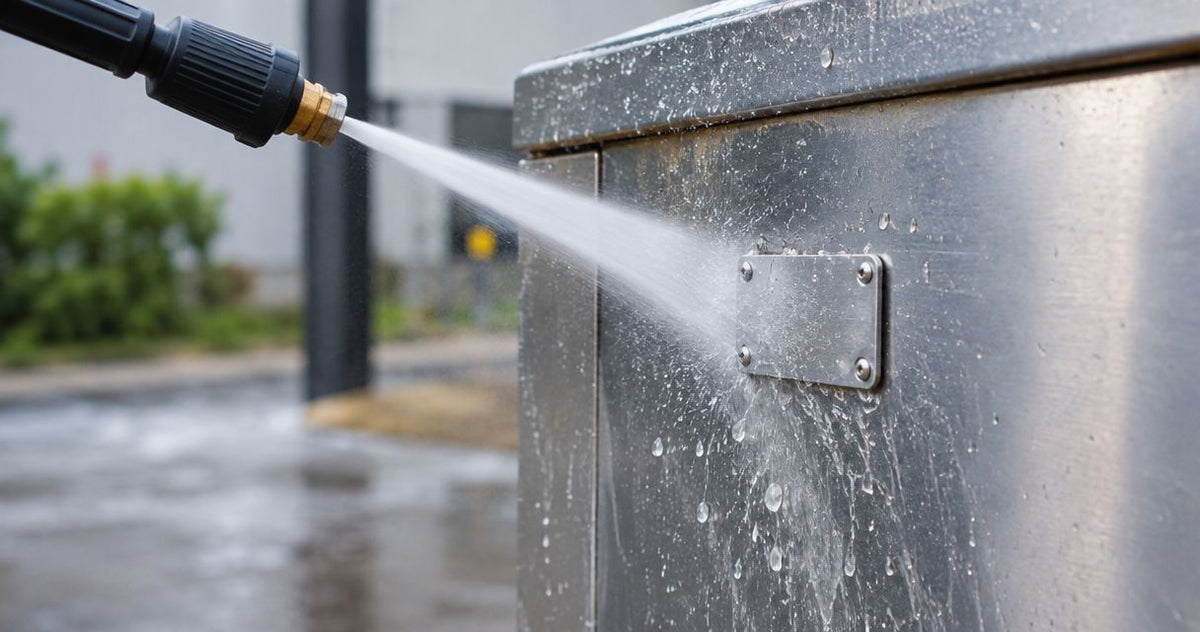
Yes—metal asset tags can withstand pressure washing when the tag material, marking, attachment, and installation are suitable for the actual wash conditions. A metal face alone does not make a tag pressure-wash resistant: the marking can become unreadable, an adhesive edge can lift, or a mounting point can fail. For a 2026 equipment-labeling specification, require evidence for the complete installed tag rather than accepting a general waterproof claim.
- Metal asset tags pressure washing performance depends on the marking, attachment, surface, and wash conditions—not appearance alone.
- Solid metal plates and metallized polyester labels are different constructions; specify the actual material before ordering.
- McAuley Labels offers adhesive asset tags; confirm the exact construction and wash suitability before selecting a label.
- Approve tags only after checking attachment, readable identification, and scanning under your actual cleaning procedure.
Can metal asset tags withstand pressure washing?
Yes, but resistance belongs to a specific tag-and-mounting combination, not to the word metal. A solid metal plate with a durable marking and suitable attachment is a different assembly from a silver-colored adhesive label. Neither construction earns a pressure-washing approval from appearance alone.
Start by identifying the construction. The guide to using polyester labels for industrial equipment tags addresses the flexible-label category; do not treat that category as interchangeable with a rigid metal plate.
| Tag construction | Best for | Functional advantage | Limitation to check before pressure washing |
|---|---|---|---|
| Solid metal plate | Equipment requiring rigid identification where suitable mounting is permitted | A rigid identification surface with mechanical mounting options | Marking resistance, attachment security, corrosion compatibility, and equipment mounting restrictions |
| Metallized polyester adhesive label | Equipment requiring flexible, adhesive identification | Fits an adhesive-label workflow without mounting holes | Adhesive bond, exposed edges, printed image, and any protective coating |
These are selection categories, not wash ratings. For either option, obtain documentation covering the exact material, marking method, attachment, and cleaning exposure.
A successful wash leaves more than a tag attached. You need the correct asset number, readable text, and a barcode or QR code that still retrieves the right equipment record.
Why this matters
An attached tag with an unreadable code has failed its identification job. So has a readable tag that detaches and becomes separated from the equipment it identifies.
Pressure washing combines water impact with the effects of temperature, detergent, and the way the operator moves the nozzle. A waterproof description does not establish resistance to that combined exposure.
For your 2026 purchasing checklist, define the result you need: secure attachment, readable identification, and reliable scanning after the approved cleaning process. Keep equipment-cleaning approval separate from tag approval; a tag that tolerates washing does not make the surrounding machine safe to pressure wash.
Solid metal plates: check the marking and mounting
A solid metal plate provides a rigid base, but its surface marking still needs separate review. Engraved, etched, and surface-printed identification are different marking methods. Ask which method the proposed tag uses and what cleaning exposure its supplier supports.
Do not assume that a visible groove guarantees barcode readability. A scanner needs a usable symbol, including sufficient contrast and intact surrounding clear space. Evaluate the actual finished code rather than approving the substrate alone.
Mechanical attachment also needs engineering approval. Rivets or screws require a suitable mounting location, and drilling into an enclosure, guard, or structural component is not automatically acceptable.
Best for: equipment that permits a rigid plate and an approved attachment method. The limitation is installation: the plate, fasteners, equipment surface, and marking must all suit the application.
Ask the equipment manufacturer about permissible mounting points before making holes. Inspect existing mounts during tag qualification rather than assuming a secure-looking plate has an approved installation.
Metallized polyester labels: check the bond and printed image
Metallized polyester is a film construction, not a solid metal plate. Its silver appearance does not establish the thickness, adhesive chemistry, print protection, or cleaning resistance of the finished label.
An adhesive tag depends on contact with the equipment surface. Oil, residue, loose paint, surface texture, and curvature all affect that installation; the label supplier's preparation and application instructions control how you qualify the bond.
Pressure washing also exposes the printed image. A film that remains intact does not prove that its ink, transferred image, or coating will remain readable after the same cleaning process.
Best for: equipment that needs flexible identification without mounting holes, provided the exact label passes the intended wash procedure. The limitation is that the adhesive interface and exposed label edges remain part of the durability assessment.
McAuley Labels asset tags include metallized silver barcode labels for equipment. McAuley Labels is best suited to buyers seeking adhesive asset identification, not buyers using a silver finish as proof of pressure-wash resistance. Confirm wash suitability for the specific label before approving it.
Why pressure-washing resistance varies
The same tag construction can face different cleaning exposures on different equipment. Include these factors in your 2026 specification so approval describes a repeatable process rather than an operator's general impression.
- Water impact: nozzle type, working distance, spray direction, and time spent over the tag determine the exposure at its face and edges.
- Temperature: review both application conditions and cleaning temperature against the tag supplier's instructions.
- Cleaning chemicals: identify the detergent, dilution, contact time, and rinse procedure. Water resistance does not establish chemical compatibility.
- Surface condition: document the equipment material, coating, texture, cleanliness, and curvature where the tag will sit.
- Tag construction: specify the substrate, marking method, protective layer if present, and attachment—not merely the finish or color.
- Repeated exposure: assess the recurring cleaning routine. A successful initial wash establishes only the result of that particular check.
Avoid specifying washer pressure alone. A pressure setting without the nozzle, distance, temperature, chemical exposure, and washing technique does not fully describe the test.
How do you test asset tags before pressure washing equipment?
Test the finished tag on a representative surface using an equipment-approved cleaning procedure. Approve the installed identification system, not an unattached material sample.
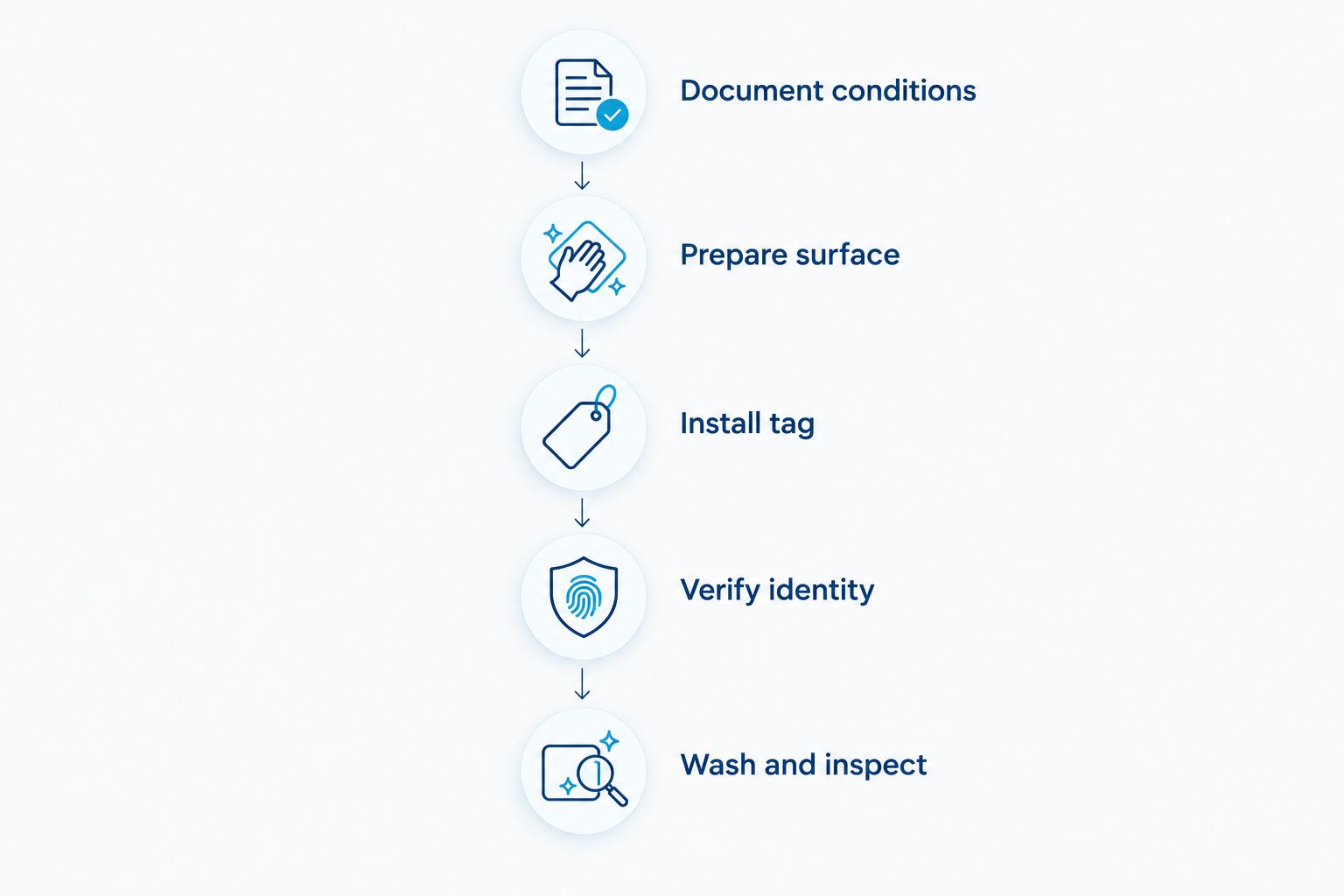
Use this sequence in your 2026 qualification record. Treat it as a practical acceptance workflow, not as a substitute for a required industry test standard.
- Document conditions. Record the washer setting, nozzle, distance, water temperature, detergent, dilution, and contact time. Use the same units throughout the record.
- Prepare surface. Follow the label or mounting instructions on a surface representative of the equipment, including its coating and curvature.
- Install tag. Use the intended attachment and location. For adhesive labels, follow the specified application conditions and waiting period before exposure.
- Verify identity. Photograph the tag, read its asset number, and scan its code into the equipment record before washing.
- Wash and inspect. Follow the approved procedure, then check attachment, edges, marking, scan performance, and the underlying surface.
The installation is part of the test. A sample applied to a clean flat panel does not establish the result on a textured, painted, or curved machine housing.
Record deviations instead of quietly changing the procedure. If an operator moves closer to remove stubborn dirt, that change belongs in the record because it changes the exposure you are evaluating.
Define pass and fail before the test
A clear acceptance checklist prevents an attached but unusable tag from passing. Specify the following outcomes before washing begins:
- The tag remains securely attached, without loose mounting hardware or lifted adhesive edges.
- The asset number remains readable and matches the equipment record.
- The barcode or QR code reads with the device used in your workflow.
- The tag face and any protective layer show no damage that prevents identification.
- The equipment surface and approved attachment points remain acceptable.
Inspect after drying as well as immediately after washing. Repeat the actual cleaning routine as required by your operating requirements, and record the exposure achieved rather than converting a short trial into an unsupported service-life claim.
What should you ask the supplier before ordering?
Ask for the exact construction and the conditions behind any durability statement. General terms such as permanent, industrial, waterproof, and heavy-duty do not describe a pressure-washing procedure.
Send the supplier a concise application brief. Include the equipment surface, proposed location, cleaning chemicals, wash settings, code format, and how your team checks identification after cleaning.
Request answers to these questions:
- Is the tag a solid metal plate, metallized film, or another construction?
- What creates the identification mark, and is a protective layer included?
- What attachment or adhesive does this specific configuration use?
- What surface preparation and application conditions are required?
- What documented cleaning exposure applies to the finished tag?
- Which changes require another suitability review?
For a 2026 purchase order, identify the approved configuration clearly enough that a replacement uses the same material, marking, and attachment. A familiar product description is not a substitute for that specification.
If you print labels in-house, include the actual label stock, ribbon where applicable, print settings, and finished code in qualification. Printer resolution describes image detail; it does not establish pressure-washing resistance.
Is waterproof the same as pressure-wash resistant?
No—waterproof does not establish pressure-wash resistance. You need the conditions behind the claim, including whether it addresses water contact, immersion, spray, or the actual cleaning process you use.
Do not transfer a rating from nearby equipment to its tag. An enclosure's rating does not certify an adhesive label, printed barcode, or mounting assembly attached to that enclosure.
Can you pressure wash directly over a barcode or QR code?
Only treat direct washing as acceptable when the finished code and attachment are qualified for that exposure. Keep the equipment manufacturer's cleaning restrictions in force and follow the tag supplier's documented limits.
After washing, check the decoded information, not just whether the scanner beeps. A usable asset tag must return the intended equipment identifier.
Should you replace a tag that starts lifting?
Yes—treat a lifting adhesive edge as a failed acceptance check and correct the cause before replacement. Inspect surface preparation, curvature, application conditions, placement, and wash technique rather than applying the same tag again without review.
Keep the replacement tied to the existing asset record. Remove or retire the damaged identifier through your normal tracking procedure so the equipment does not acquire conflicting identities.
FAQ
Can all metal asset tags withstand pressure washing?
No. Pressure-washing suitability depends on the exact substrate, marking, attachment, installation, and cleaning conditions. Approve the complete installed tag rather than metal as a general category.
Are silver asset labels made from solid metal?
Not necessarily. Metallized polyester labels use a film construction, while solid metal tags use a metal substrate. Confirm the material specification instead of relying on the silver appearance.
What pressure setting is safe for an asset tag?
Use only conditions supported for the specific installed tag and permitted for the equipment. Washer pressure alone does not define exposure; nozzle type, distance, temperature, chemicals, and technique also belong in the assessment.
Are riveted tags better than adhesive tags for pressure washing?
Neither attachment is automatically approved for pressure washing. Riveted tags require suitable mounting points and compatible materials; adhesive tags require an appropriate bond, surface preparation, and exposure qualification.
Can I use McAuley Labels asset tags on pressure-washed equipment?
Confirm the exact tag's suitability before using McAuley Labels asset tags on pressure-washed equipment. Specify the surface, cleaning process, and identification requirements, then qualify the installed label before deployment.
Does a readable asset number mean the barcode still works?
No. Human-readable text and machine-readable codes require separate checks. Scan the code with your normal device and confirm that it retrieves the correct asset record.
Should I test a replacement label if the material changes?
Yes. A change to the substrate, adhesive, marking, protective layer, or mounting changes the assembly you previously approved. Review the change and repeat the relevant qualification before using the replacement.
One last thing
Location is part of the tag specification. An easily scanned position that avoids routine direct spray is worth evaluating before changing materials, provided it remains accessible and complies with equipment-cleaning requirements.
Photograph the approved location and include it in installation instructions. A replacement tag installed somewhere else is no longer the same tested arrangement, even when its material and asset number match.