
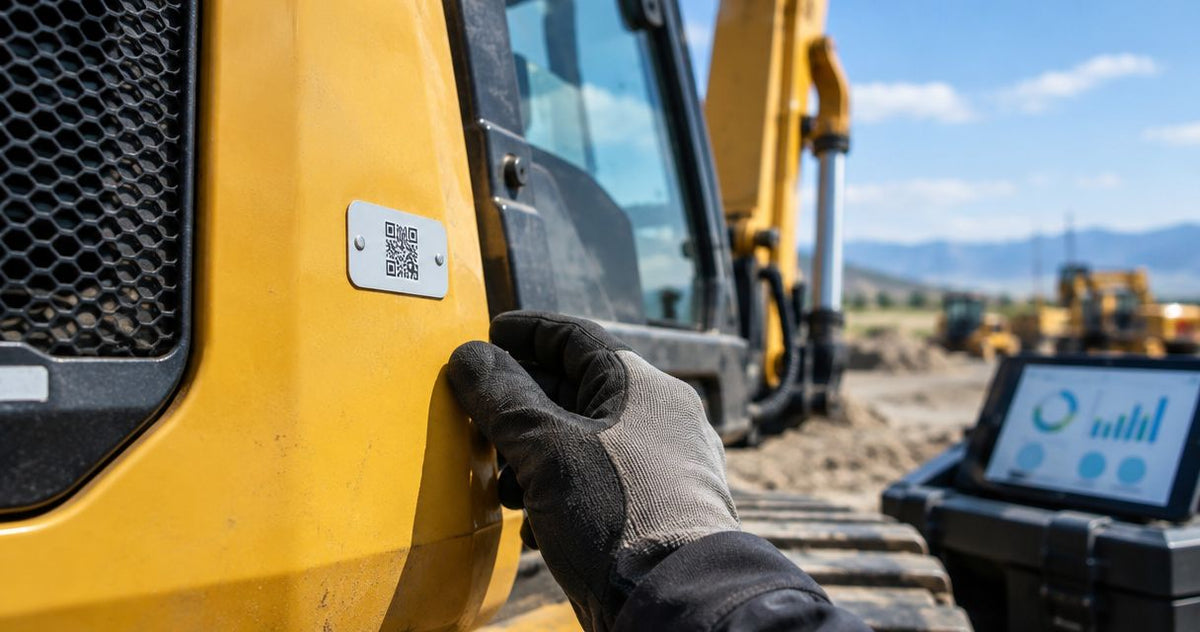
An outdoor asset tag lasts only as long as its adhesive holds and its identifier stays readable; there is no single lifespan that applies to every material, print method, and equipment surface in 2026. Use the finished tag’s documented outdoor service life for your conditions—not a general claim such as waterproof, permanent, or heavy-duty—to set a replacement interval.
- How long do asset tags last outdoors? Use the finished label’s outdoor rating, not its material name alone.
- Waterproof asset tags still need suitable UV resistance, adhesion, and readable barcode printing.
- McAuley Labels asset tag printers suit businesses that need to print equipment identifiers in-house.
- Replace outdoor equipment labels when adhesion or scan reliability fails, even if the label remains attached.
How long does an asset tag last on outdoor equipment?
The useful life of an outdoor asset tag ends when it stops identifying the equipment reliably. A label that remains attached but no longer scans has failed its tracking purpose. A readable tag with lifting edges also needs attention before it detaches.
For your 2026 purchasing specification, separate the following checks instead of treating durability as a single property:
| What must last | What to verify | What counts as failure |
|---|---|---|
| Label face | Outdoor suitability of the exact material and construction | Cracking, tearing, or deterioration that affects identification |
| Printed identifier | Resistance of the finished print to its actual exposure | Faded text, damaged bars, or an unreadable QR code |
| Adhesive bond | Compatibility with the equipment surface and service conditions | Edge lifting, sliding, or detachment |
| Asset-record connection | Correct identifier and working destination | A readable code that opens the wrong or inaccessible record |
For a closer look at the difference between water resistance and outdoor service life, read how long waterproof labels actually last outdoors.
A material rating is useful only when its conditions match your application. Check whether the stated life concerns the unprinted label face, the adhesive, or the complete printed construction. Those are different purchasing questions.
Why this matters
Outdoor equipment identification is a system, not just a sticker. The surface, adhesive, label face, printed image, and asset record all have to work together. Improving one part does not correct a failure elsewhere.
A mower stored under cover and a machine parked in direct sunlight do not present identical exposure. Neither does a sheltered equipment cabinet and a pressure-washed housing. Describe the actual use before choosing a label.
Buy against the exposure you have, not the durability adjective on the listing. Your specification should explain where the label sits, what touches it, how you clean it, and how workers read it.
Why outdoor asset tag life varies
These factors determine what you need to check before assigning a service interval:
- Sunlight exposure: Ask about UV resistance of the printed construction, not just whether the base material tolerates water.
- Temperature exposure: Check both the application-temperature requirements and the service-temperature limits. Installation and operation are separate conditions.
- Surface condition: Oil, dust, loose paint, corrosion, and moisture interfere with a dependable adhesive bond. Surface compatibility matters even after cleaning.
- Water and cleaning: Rain, immersion, pressure washing, and chemical cleaning are different exposures. Identify the cleaning products and methods used on the equipment.
- Abrasion and handling: Boots, straps, tools, vegetation, and repeated contact can damage the face or printed code. Placement is part of protection.
- Print construction: The label stock, ribbon or imaging method, and any protective layer must work together. A durable face does not automatically mean durable print.
Record these conditions in your 2026 equipment-label specification. A supplier can assess a defined application more accurately than a request for a label that simply lasts outdoors.
Sheltered outdoor equipment
Best for: equipment with a readable location protected from routine contact and direct weather. A sheltered position reduces some exposure, but it does not turn an indoor label into an outdoor-rated construction.
The benefit is protection without adding another covering. The limitation is access: a deeply recessed tag is less useful if workers cannot see it or position a scanner correctly. Test the location during a normal inspection.
Fully exposed outdoor equipment
Best for: an outdoor-rated construction assessed against direct weather and sunlight. Specify the actual surface and whether equipment remains exposed during storage as well as operation.
The benefit of an appropriate construction is a better match to the application. The limitation is that an outdoor rating does not establish resistance to every cleaner, scraping action, or washing method. Confirm those exposures separately.
Frequently washed or heavily handled equipment
Best for: a protected label position combined with documented resistance to the cleaning process. Treat washdown and physical wear as explicit requirements, not incidental details.
A suitable placement keeps the tag away from routine rubbing and direct spray where practical. The trade-off is visibility. Do not hide the identifier so thoroughly that staff bypass scanning and type records manually.
Which asset tag materials should you compare?
Compare the complete label specification before choosing between silver, white, or heavy-duty constructions. Color and product naming do not establish an outdoor lifespan. Ask for the face material, adhesive information, print protection, and relevant exposure limits.
The following are candidates to evaluate, not a ranking of proven outdoor service life:
| Candidate | Best for | Practical benefit | Limitation to resolve |
|---|---|---|---|
| Custom QR Asset Tags for Equipment - 3M Heavy-Duty Silver - QR Code Stickers | Buyers evaluating heavy-duty QR equipment identification | QR format connects a physical identifier with a digital workflow | Confirm the exact outdoor, cleaning, and surface requirements before specifying it |
| Custom QR Asset Tags for Equipment - Numbered, Permanent, Adhesive, Metallized Silver - QR Code | Buyers evaluating numbered adhesive QR equipment tags | Combines numbering with a scannable identifier | Permanent adhesive and a silver finish do not establish a calendar lifespan |
McAuley Labels supplies these asset tag options; select between them using the finished construction’s suitability for your equipment. Neither product name alone answers how long the label will remain readable on your particular machine.
Do not treat metalized polyester as a solid metal plate. A film label and a mechanically attached plate are different constructions. If your application requires a rigid plate, specify that requirement directly rather than choosing by silver appearance.
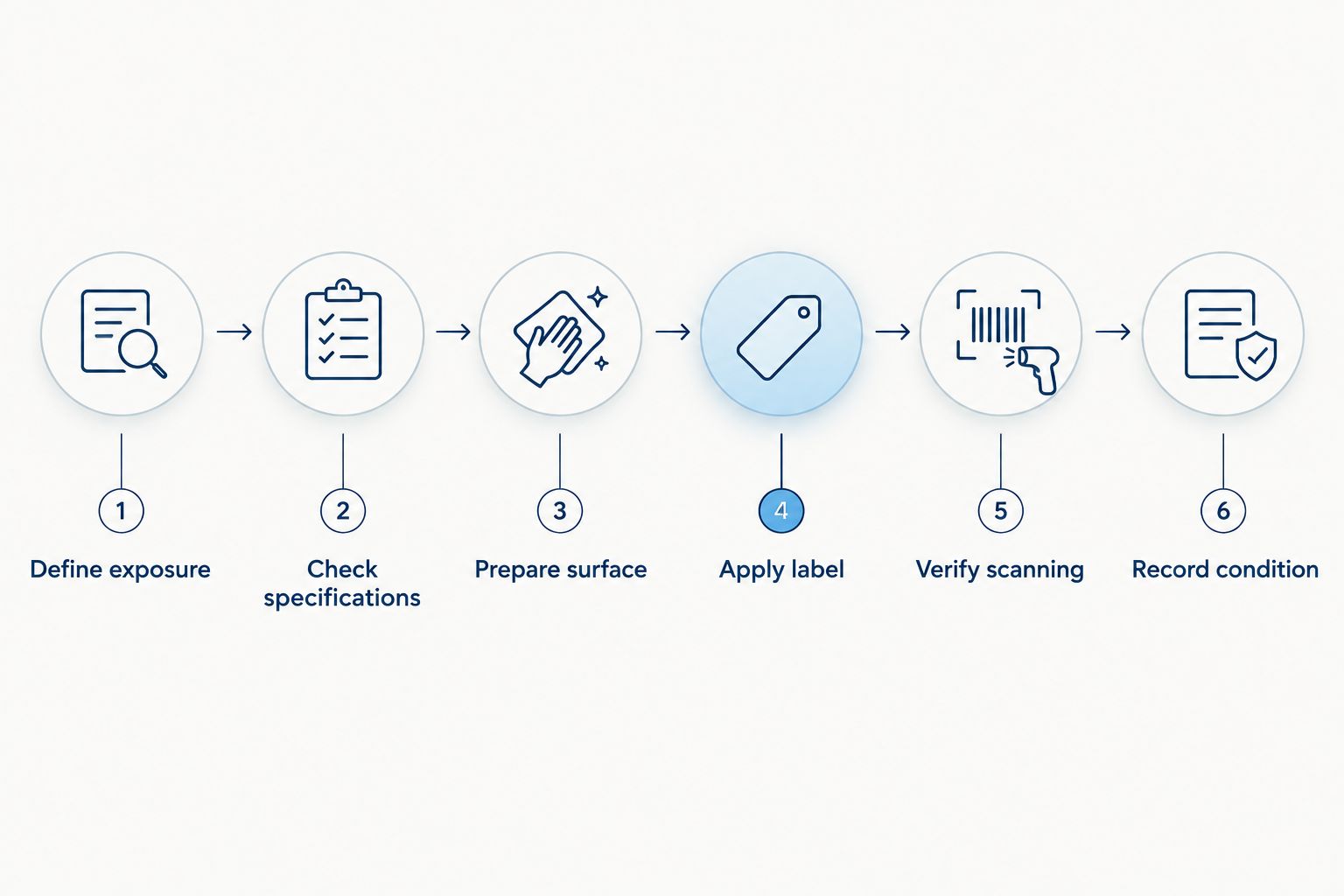
How do you check an asset tag before labeling the fleet?
Use a controlled application check on representative equipment before standardizing a label. Keep the identifier layout, surface preparation, installation position, and printing method consistent so you can identify what causes a failure.
- Define exposure. Record sunlight, storage conditions, cleaning methods, operating heat, and routine contact at the intended location.
- Check specifications. Confirm that the exact label construction is suitable for the surface and stated service conditions. Follow the supplier’s application instructions.
- Prepare surface. Remove contamination using a method compatible with the equipment finish and the label instructions. Let the surface reach the required condition before application.
- Apply label. Use a position with full adhesive contact. Avoid bridging seams, loose coatings, sharp changes in shape, and areas exposed to repeated scraping.
- Verify scanning. Read the identifier with the device staff actually use, then confirm that it retrieves the correct asset record.
- Record condition. Photograph the installation and record the application date, label construction, equipment surface, and print setup. Recheck during normal service and after relevant exposure.
This process makes failures easier to diagnose. If the edges lift but the print remains clear, investigate adhesion and placement. If the bond holds but the code fades or scuffs, investigate the printed construction and contact exposure.
A field check shows how a label behaves under the conditions it actually experiences. It is not a substitute for a documented long-term rating, and a brief successful trial does not establish years of outdoor service.
Does the printer determine how long an outdoor asset tag lasts?
The printer determines how you produce the identifier; the complete printed label determines outdoor suitability. Resolution alone is not a weather-resistance specification. Choose the printing method, label stock, and consumables together.
Thermal transfer printing uses a ribbon to form the image on compatible media. Direct thermal printing forms the image on heat-sensitive media without a ribbon. These methods have different material requirements, so do not assume their labels are interchangeable.
For long-term outdoor identification, evaluate a thermal transfer construction with documented suitability for the exposure. Its advantage is the ability to match the ribbon and label stock to the application. Its limitation is that an unsuitable combination still produces an unsuitable outdoor label.
Direct thermal printing avoids ribbon handling, which simplifies consumables. Its heat-sensitive image requires careful assessment for light, heat, and expected identification life. Do not select it for permanent outdoor tracking solely because the printer is convenient.
McAuley Labels asset tag printers are best for businesses that need to print equipment identifiers in-house. Before choosing a printer for a 2026 rollout, confirm media compatibility, code readability, and the finished label’s exposure requirements—not just the printer’s resolution.
When should you replace an outdoor asset tag?
Replace an outdoor asset tag when its identification function becomes unreliable, not only when it falls off. Check the printed code, the human-readable identifier, the adhesive edges, and the record the code retrieves.
Use these replacement triggers during equipment maintenance:
- The barcode or QR code fails to read reliably with the normal scanning device after appropriate cleaning.
- The printed identifier is faded, scratched, or incomplete.
- Edges lift, the label moves, or part of the adhesive bond separates.
- Cracks, tears, or surface damage reach the identifier.
- The code retrieves the wrong record or an inaccessible destination.
Keep the asset’s existing identity when replacing the physical label unless your tracking procedure explicitly requires a change. An unnecessary new identifier can split the equipment’s maintenance history across records.
For your 2026 maintenance records, log replacement reasons separately. Adhesive failure, print wear, physical damage, and record-access problems call for different corrections. A replacement count without a failure reason does not tell you what to change.
Will moving the label make it last longer?
A protected location reduces exposure, but it does not replace a suitable label construction. Move the tag away from routine abrasion, standing water, direct spray, and hot components where the equipment design allows.
Check readability before committing to the position. A protected tag still needs a practical scanning angle, enough room for the complete code, and safe access during normal work. Avoid placing it where inspection requires reaching near moving parts or removing a frequently lost cover.
FAQ
How long do asset tags last outdoors?
Outdoor asset tags have no universal lifespan. Use the finished label’s documented outdoor service life for the actual surface, sunlight, temperature, cleaning, and wear conditions, then inspect adhesion and readability during service.
Does waterproof mean an asset tag will last outdoors?
Waterproof does not establish outdoor service life. Check UV resistance, printed-image durability, adhesive compatibility, and resistance to the equipment’s cleaning process separately.
Are heavy-duty asset tags guaranteed to last longer?
A heavy-duty name alone does not prove a longer outdoor lifespan. Compare the exact constructions and their documented exposure limits before choosing.
Can I use direct thermal labels on outdoor equipment?
Use direct thermal labels outdoors only when the exact printed construction is suitable for the expected exposure and identification period. Heat-sensitive media require particular attention to light and heat.
Should I replace a tag if it still sticks but will not scan?
Yes, replace a tag that no longer scans reliably when scanning is part of your tracking process. First rule out removable dirt, a scanner problem, or an incorrect asset-record connection.
Does silver polyester mean the tag is made of metal?
No, metalized polyester is a film construction, not a solid metal plate. Specify a rigid plate separately if that is what your equipment application requires.
Can McAuley Labels help with printing asset tags in-house?
McAuley Labels manufactures asset tag printers for businesses. Match the printer, compatible media, and printing consumables to your identifier layout and outdoor exposure requirements.
One last thing
A perfectly readable QR code can still fail as an asset tag if its destination stops working. Physical durability and record access need separate checks.
Use a stable asset identifier, retain a human-readable version where your layout permits, and verify the destination during maintenance. When you replace the sticker, preserve the equipment’s history rather than starting its record again.