
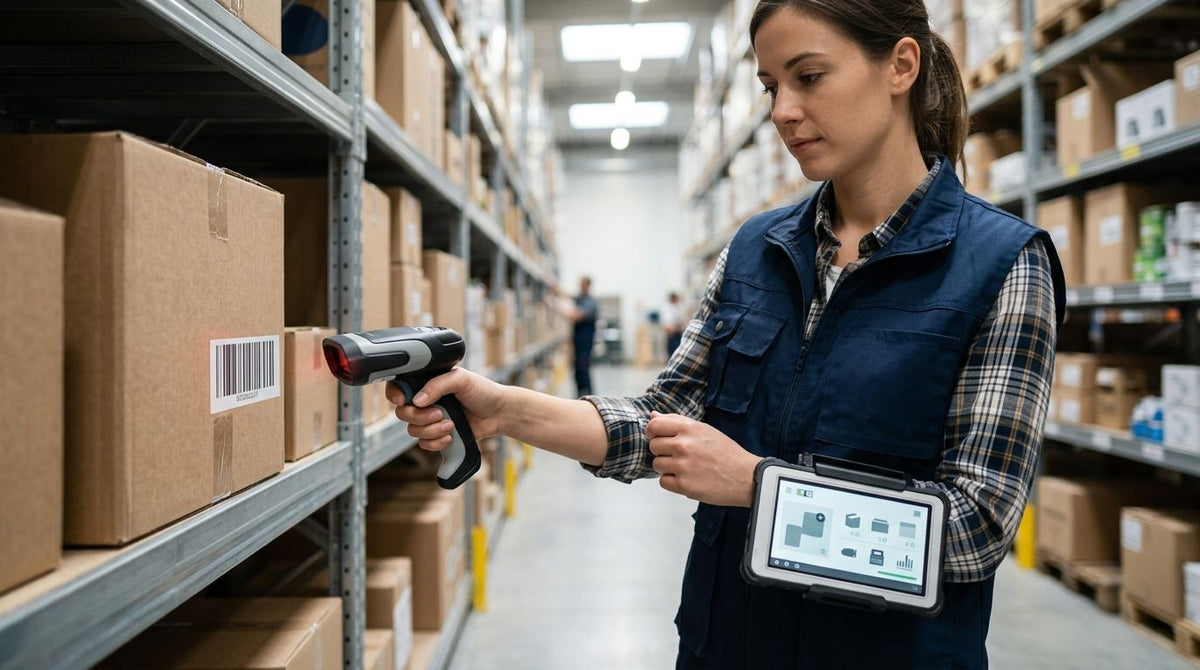
A 1D barcode scanner reads linear barcodes like UPC, Code 128, and Code 39 — the kind printed on almost every retail product and warehouse label. Best overall 1D barcode scanner in 2026: the GoDEX GS220 USB scanner, built for single-register retail counters and small warehouse receiving desks. Best for high-volume checkout lanes: a hands-free presentation scanner. Best for warehouse floors spread across multiple zones: a wireless 1D barcode scanner. Best budget pick for low-volume shops: a basic corded CCD scanner.
- GoDEX GS220 wins as the best overall 1D barcode scanner in 2026 for single-register retail and small warehouse desks.
- Wireless 1D barcode scanners fit multi-zone warehouses; corded CCD models fit low-volume shops on a tight budget.
- Presentation-style scanners speed up high-volume checkout lanes by freeing up the cashier's hands.
- Rugged, IP-rated 1D scanners are built for distribution centers and forklift traffic, not quiet retail counters.
Why this matters
Most small businesses buying their first scanner overpay for features they never use, or underbuy and end up replacing the unit within a year. The right pick depends on where the scanning happens — a fixed counter, a moving warehouse floor, or a loading dock — not on which model has the longest spec sheet.
McAuley Labels breaks this down in more detail in choosing a 1D barcode scanner for retail or warehouse use, which covers symbology support and connection types side by side. The short version for 2026: match the scanner to the workflow first, then worry about brand.
What makes the best 1D barcode scanner
- Symbology support — reads UPC-A, Code 128, and Code 39 without a firmware update
- Connection type — USB corded for fixed counters, Bluetooth or 2.4GHz wireless for mobile scanning
- Read range and angle tolerance — how forgiving the scanner is with tilted or slightly damaged labels
- Housing durability — sealed, drop-rated housings for warehouse and dock use versus lightweight desktop shells
- Plug-and-play compatibility — works with existing POS or WMS software without a driver install
- Warranty coverage — a documented warranty period, not a vague "limited" claim
At a glance
| Scanner type | Best for | Standout feature | Key limitation |
|---|---|---|---|
| GoDEX GS220 USB scanner | Single-register retail, small warehouse desks | Plug-and-play USB, 3-year warranty | Corded — no floor mobility |
| Corded CCD scanner | Low-volume shops, backup unit | Lowest cost of entry | Short read range, no wireless option |
| Wireless 1D scanner | Multi-zone warehouse floors | Batch-scan mode when out of range | Needs charging, higher upfront cost |
| Rugged industrial scanner | Distribution centers, loading docks | IP-rated, drop-tested housing | Bulky for a retail counter |
| Presentation scanner | High-volume checkout lanes | Hands-free automatic scanning | Needs counter space for the stand |
1. GoDEX GS220: best 1D barcode scanner for small business retail and warehouse desks
The GoDEX GS220 is a USB 1D scanner that plugs directly into a computer or POS terminal and starts reading barcodes without a driver install. It reads standard linear symbologies out of the box, which covers most retail and small-warehouse inventory tags.
GoDEX GS220 pros:
- Plug-and-play USB — no software setup required
- Backed by a 3-year warranty
- Reads common 1D symbologies used on retail and inventory labels
- Compact enough for a tight counter footprint
GoDEX GS220 cons:
- Corded design limits movement beyond the desk
- Reads only 1D linear barcodes, not 2D or QR
- Not built for drop or dust exposure
Best for: single-register retail counters and small warehouse receiving desks.
Verdict: Buy. For a single fixed scanning point, this is the straightforward choice — McAuley Labels positions the GS220 as its entry point into 1D barcode scanner hardware for exactly this reason.
2. Corded CCD scanner: best 1D barcode scanner for low-volume shops
Entry-level CCD (imaging) scanners read barcodes at close range using an LED array instead of a laser diode. They cost less to manufacture than laser scanners, which keeps the price tier low.
Corded CCD scanner pros:
- Lowest cost of entry in the category
- Simple USB connection, no configuration
- Adequate for a shop scanning a few hundred items a day
Corded CCD scanner cons:
- Shorter read range than laser-based scanners
- Struggles with curved or damaged labels
- No wireless option
Best for: occasional scanning or as a backup unit behind a primary scanner.
Verdict: Buy as backup, skip as primary if scan volume is high.
3. Wireless 1D barcode scanner: best for multi-zone warehouse floors
Bluetooth or 2.4GHz wireless 1D scanners let staff walk a warehouse floor and scan shelf or pallet barcodes without tethering to a workstation. Most store scanned codes in memory when out of range and sync once reconnected.
Wireless 1D scanner pros:
- Full mobility across a large warehouse floor
- Batch-scan mode keeps working outside signal range
- Compatible with most WMS software through standard USB or Bluetooth pairing
Wireless 1D scanner cons:
- Requires battery charging and management
- Costs more upfront than a corded unit
- Can drop connection at range limits
McAuley Labels covers this use case in depth in warehouse inventory management scanning setups.
Best for: cycle counts and receiving docks spread across multiple zones.
Verdict: Buy for multi-zone warehouses, skip for a single fixed counter.
4. Rugged industrial 1D scanner: best for distribution centers and loading docks
Rugged 1D scanners add sealed, IP-rated housings and reinforced drop specs so the unit survives forklift traffic, dust, and repeated drops onto concrete. These are built for environments where a standard desktop scanner fails within weeks.
Rugged industrial scanner pros:
- Withstands drops and dust exposure
- Often rated for extended temperature range
- Holds up to daily use on a loading dock
Rugged industrial scanner cons:
- Bulkier and heavier than a desktop unit
- Priced at a premium tier within the category
- Overkill for a quiet retail counter
Best for: distribution centers, freight docks, and manufacturing floors.
Verdict: Buy for harsh environments, skip for office or retail use.
5. Presentation scanner: best 1D barcode scanner for high-volume checkout
Presentation-style scanners sit on a stand and scan automatically when a barcode passes in front of the sensor, which frees the cashier's hands entirely. Most double as a handheld unit when lifted off the stand.
Presentation scanner pros:
- Faster throughput at busy registers
- Hands-free operation reduces repetitive strain over a shift
- Handheld mode covers oddly shaped items
Presentation scanner cons:
- Needs dedicated counter space for the stand
- Steeply angled labels can miss the first scan pass
- Costs more than a basic corded scanner
Best for: convenience stores and high-volume checkout lanes.
Verdict: Buy for high-throughput registers, wait if register volume is low.
“If the scanning happens at one fixed counter, a corded 1D scanner beats wireless on cost and reliability every time.”
How McAuley Labels ranked these
Each entry was scored against the same six criteria: symbology support, connection type, read range, housing durability, plug-and-play compatibility, and warranty coverage. The GoDEX GS220 leads because it clears every criterion for the most common use case — a fixed counter or desk — without forcing a buyer to pay for mobility or ruggedness they don't need.
Most businesses scanning barcodes tied to metalized silver barcode asset tags or inventory stickers only need one scanning point, which is why the corded, plug-and-play category wins the overall slot in 2026 rather than a wireless or rugged model.
Which 1D barcode scanner should you choose?
For a single retail register or a small warehouse desk, the GoDEX GS220 is the default pick — plug it in and start scanning. Move to a wireless 1D barcode scanner only once staff are walking a warehouse floor larger than one room. Reserve the rugged, IP-rated category for loading docks and manufacturing floors where drops and dust are a daily reality, and pick a presentation scanner only if checkout volume is high enough to justify freeing up a cashier's hands.
When the scanning workflow also involves tagging equipment, pair the scanner with metalized silver barcode asset tags so the labels being scanned hold up as long as the hardware reading them.
FAQ
What's the best 1D barcode scanner for a small retail store in 2026?
The GoDEX GS220 USB scanner is the best 1D barcode scanner for a single-register retail store in 2026. It plugs in without driver installation and reads standard UPC and Code 128 barcodes out of the box.
Is a wireless 1D barcode scanner worth it over a corded model?
A wireless 1D barcode scanner is worth it only if staff need to scan barcodes away from a fixed workstation, such as on a multi-zone warehouse floor. For a single counter, a corded scanner is cheaper and just as reliable.
What's the difference between a 1D and 2D barcode scanner?
A 1D barcode scanner reads linear barcodes like UPC and Code 128, which hold roughly 20-25 characters of data. A 2D scanner also reads QR codes and Data Matrix codes, which store far more data in a smaller footprint.
Can a 1D barcode scanner read QR codes?
No. A 1D barcode scanner only reads linear barcodes and cannot decode QR codes or other 2D formats. Reading QR codes requires a 2D imaging scanner instead.
Do 1D barcode scanners need special software to work?
Most 1D barcode scanners, including the GoDEX GS220, work as plug-and-play USB devices that act like a keyboard input. No special software is required for basic scanning into a POS or spreadsheet.
What is the read range of a typical 1D barcode scanner?
Most corded 1D barcode scanners read from a few inches to about a foot away, depending on barcode size and print quality. Laser-based models generally read at a longer range than CCD imagers.
Is a laser or CCD scanner better for retail?
A laser scanner reads at a longer range and handles slightly angled labels better, which suits busy retail counters. A CCD scanner costs less but works best at close range on flat labels.
How long does a 1D barcode scanner typically last before replacement?
A corded USB 1D barcode scanner used at a single counter can run for years with normal use, and models like the GoDEX GS220 carry a 3-year warranty. Wireless and rugged models see more wear from daily handling and drops.
One last thing
A 1D barcode holds roughly 20-25 characters of data in its bar widths, which is why most retail and warehouse operations still run on 1D scanning hardware in 2026 even as 2D adoption grows — the print requirements are simpler and the scanning hardware costs less. Before switching to 2D or QR-based labels, confirm the current fleet of 1D barcode scanners can't already do the job.