
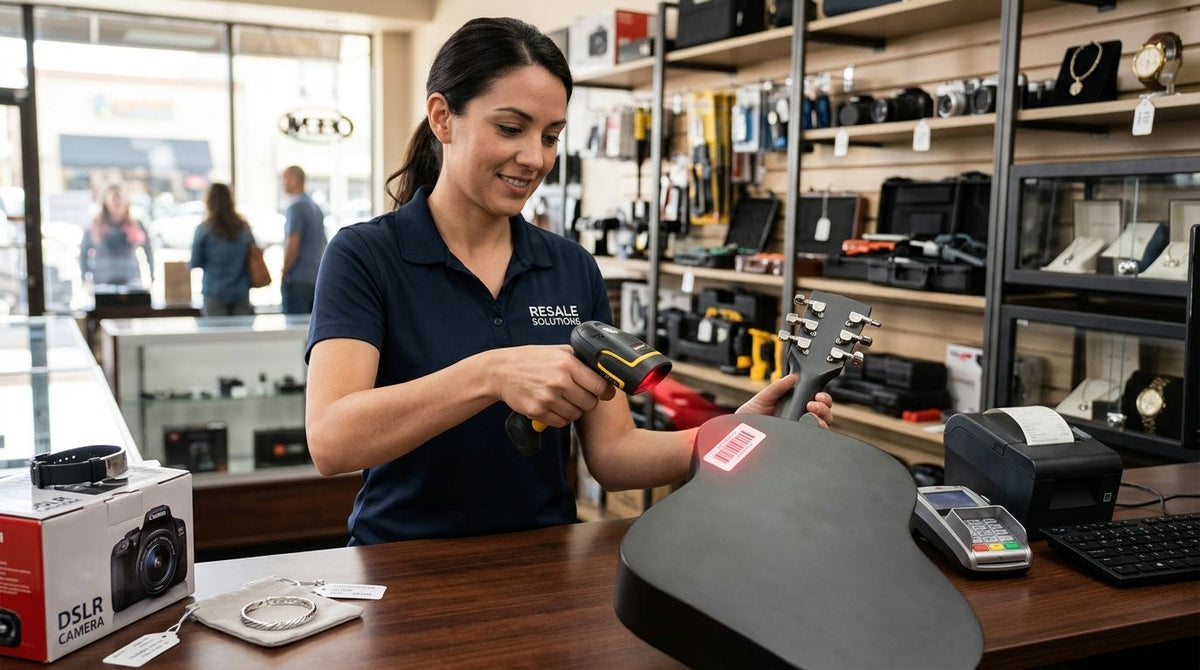
Pawn shops process more serialized, one-off items per day than most small retailers, and the wrong scanner slows down intake, ticket printing, and driver's license verification at the counter. This guide ranks the barcode scanner for pawn shops options for 2026, from a plug-and-play USB scanner built for one counter to 2D imagers that read the PDF417 barcode on a driver's license.
- GoDEX GS220 USB scanner wins for pawn shop counters that only need fast 1D reads on ticket tags.
- 2D imager scanners are required if staff scan driver's license PDF417 barcodes during intake in 2026.
- Wireless Bluetooth 2D scanners cost more but free up staff to scan items in a vault, yard, or back room.
- Pair any barcode scanner for pawn shops with heavy-duty asset tags so tickets survive months on a shelf.
Why this matters
A pawn transaction generates a paper trail before a sale ever happens: an intake ticket, a customer ID scan, and a shelf tag that has to stay readable for weeks or months while the loan sits. A scanner that only reads 1D barcodes can log the ticket but can't pull data off a driver's license, which forces staff to retype names and ID numbers by hand. That's the single biggest mismatch shops run into when they buy a scanner built for grocery checkout instead of pawn intake.
The heavy-duty barcode asset tags a shop puts on collateral only matter if the scanner reading them can handle a scuffed or bent tag after 60 days in a display case. Scanner choice and tag choice are the same decision, not two separate ones.
Best overall: GoDEX GS220 USB Barcode Scanner. Best for driver's license and ID verification: 2D imager scanners. Best for vault, yard, or multi-station shops: wireless Bluetooth 2D scanners. Best budget option: corded 1D USB scanners.
What makes the best barcode scanner for pawn shops
- Symbology support — 1D-only scanners read ticket and shelf barcodes but skip the PDF417 2D barcode printed on US driver's licenses
- Connection type — corded USB scanners are cheaper and need zero setup; wireless models add mobility for yards, vaults, and multi-register counters
- Read tolerance — a scanner has to fire on a barcode that's been handled, bent, or partly worn after weeks on a shelf
- POS compatibility — USB HID keyboard-emulation scanners work with almost any pawn software without a driver install
- Setup complexity — plug-and-play beats anything that needs configuration software before the first scan
- Build durability — daily counter use for years, not months, is the real test
Barcode scanner for pawn shops at a glance
| Scanner type | Best for | Standout feature | Key limitation |
|---|---|---|---|
| GoDEX GS220 USB Scanner | Everyday counter intake | Plug-and-play USB, 3-year warranty | 1D only — can't read a driver's license barcode |
| 2D imager scanners | Driver's license and ID verification | Reads PDF417 and QR in one pass | Costs more than a basic 1D corded unit |
| Wireless Bluetooth 2D scanners | Vault, yard, multi-station shops | No cord, works across a room | Needs charging and a paired base station |
| Rugged corded 1D scanners | High-volume, low-budget counters | Simple, durable, no software needed | Same 1D-only ceiling as the GS220 |
1. GoDEX GS220 USB Barcode Scanner: best barcode scanner for pawn shops for everyday counter intake
The GoDEX GS220 is a corded USB 1D scanner that plugs into a register or PC and works immediately with keyboard-emulation software — no driver, no configuration screen. It reads the ticket and shelf barcodes a pawn shop prints for its own inventory, which covers the bulk of daily scans at a single counter. It ships with a 3-year warranty, which matters for a device that gets picked up and set down dozens of times a shift.
GoDEX GS220 pros:
- Plug-and-play USB, works with most POS software out of the box
- 3-year warranty
- Low learning curve for new counter staff
GoDEX GS220 cons:
- 1D only — can't read the PDF417 barcode on a driver's license
- Corded, so it stays at one station
Best for: single-counter pawn shops that only need to scan their own printed tags. Verdict: Buy if intake tickets and shelf tags are the only barcodes you scan.
2. 2D imager scanners: best barcode scanner for pawn shops for driver's license and ID verification
A 2D imager reads both 1D barcodes and 2D symbologies, including the PDF417 barcode encoded on the back of a US driver's license. For a pawn shop, that means a single scan pulls a customer's name, address, and ID number into the intake form instead of a staffer typing it manually — a real speed difference at a busy counter in 2026.
2D imager pros:
- Reads driver's license PDF417 barcodes and QR codes in addition to standard 1D tags
- Cuts manual data entry errors during intake
- Works across ticket, shelf, and ID barcodes with one device
2D imager cons:
- Higher cost than a basic 1D corded scanner
- Overkill if a shop never scans customer IDs
Best for: shops that log ID information at intake as part of their transaction process. Verdict: Buy if driver's license scanning is part of your daily workflow.
3. Wireless Bluetooth 2D scanners: best barcode scanner for pawn shops for vault, yard, or multi-station operations
Wireless 2D scanners drop the cord and pair over Bluetooth to a register, tablet, or laptop. That matters for shops that appraise items away from the front counter — in a back vault, a fenced yard for larger equipment, or across multiple intake stations that share one inventory system.
Wireless 2D scanner pros:
- No cord, works anywhere within Bluetooth range
- Same 2D symbology support as corded imagers
- Useful across multiple stations without running new cabling
Wireless 2D scanner cons:
- Needs charging and battery management
- Typically the most expensive option in the lineup
Best for: multi-station shops or ones that appraise items away from a fixed counter. Verdict: Buy if staff regularly scan outside the front counter; Hold if a corded scanner already covers your floor plan.
4. Rugged corded 1D scanners: best barcode scanner for pawn shops for high-volume, low-budget counters
A rugged 1D corded scanner is the no-frills option — same barcode limitation as the GS220, but built for shops that just need a reliable, low-cost device scanning the same barcode formats hundreds of times a day. It's the right call for a second or third register that doesn't need ID-scanning capability.
Rugged 1D scanner pros:
- Lowest setup complexity of any option here
- Durable for constant daily use
- No software dependency beyond basic keyboard emulation
Rugged 1D scanner cons:
- Can't read driver's license or QR barcodes
- No mobility — tethered to one station
Best for: a second counter that only scans internal inventory tags. Verdict: Buy for backup or overflow stations; Skip if that station also needs ID verification.


How we ranked
Each scanner type was weighed against the six criteria above: symbology support, connection type, read tolerance, POS compatibility, setup complexity, and build durability. The GoDEX GS220 ranks first because it covers the highest share of daily pawn shop scans — ticket and shelf barcodes — with zero setup. 2D imagers and wireless models move up the list only for shops that add ID verification or off-counter scanning to that workflow.
Which barcode scanner should you choose?
If your shop scans internal tickets and shelf tags all day and doesn't log ID barcodes, the GoDEX GS220 is the practical default for 2026 — corded, plug-and-play, and backed by a 3-year warranty. Add a 2D imager the moment driver's license scanning becomes part of intake, and move to a wireless Bluetooth model only once a second station or off-counter workflow actually needs it. Pair whichever scanner you pick with metalized silver inventory barcode labels so the tags on collateral hold up as long as the loan does.
FAQ
What's the best barcode scanner for pawn shops in 2026?
The GoDEX GS220 USB scanner is the best default for pawn shops that only scan internal tickets and shelf tags. Shops that also scan driver's license IDs at intake need a 2D imager instead.
Do pawn shops need a 2D barcode scanner or is 1D enough?
1D is enough if you only scan your own printed tickets and shelf tags. You need a 2D scanner the moment you scan a customer's driver's license, since that barcode uses the PDF417 2D format.
Can a barcode scanner read a driver's license?
Only a 2D imager scanner can read a driver's license. US licenses encode data in a PDF417 barcode, a 2D symbology that 1D-only scanners like corded retail units can't decode.
Is a wireless barcode scanner better than a corded one for a pawn shop?
Wireless is better only if staff scan away from a fixed counter — a vault, yard, or multi-station setup. A single-counter shop gets no real benefit from paying more for Bluetooth.
Does a barcode scanner for pawn shops need special software?
Most USB scanners, including the GoDEX GS220, use keyboard-emulation (HID) mode and work with existing pawn or POS software with no driver install required.
What barcode format do driver's licenses use?
US driver's licenses encode data in a PDF417 barcode, a 2D stacked-linear symbology defined under the AAMVA standard. A 1D-only scanner cannot decode it.
Can I use the same scanner for inventory tags and shipping labels?
Yes. A USB or 2D scanner reads any standard barcode symbology on your labels regardless of whether it's an inventory tag, shelf tag, or shipping label.
How durable does a barcode label need to be for pawn shop collateral?
Collateral can sit on a shelf for weeks or months, so a semi-gloss or metalized barcode label holds up better than plain paper. Heavy-duty 3M-backed tags are the better call for anything handled repeatedly.
One last thing
Most shops don't find out their scanner can't read a driver's license until a busy Saturday intake line forces the issue — buy the 2D imager before that moment, not after. If you're only scanning internal barcodes for now, start with the 1D scanner buying guide and upgrade to a 2D scanner for QR codes once ID scanning enters the workflow.